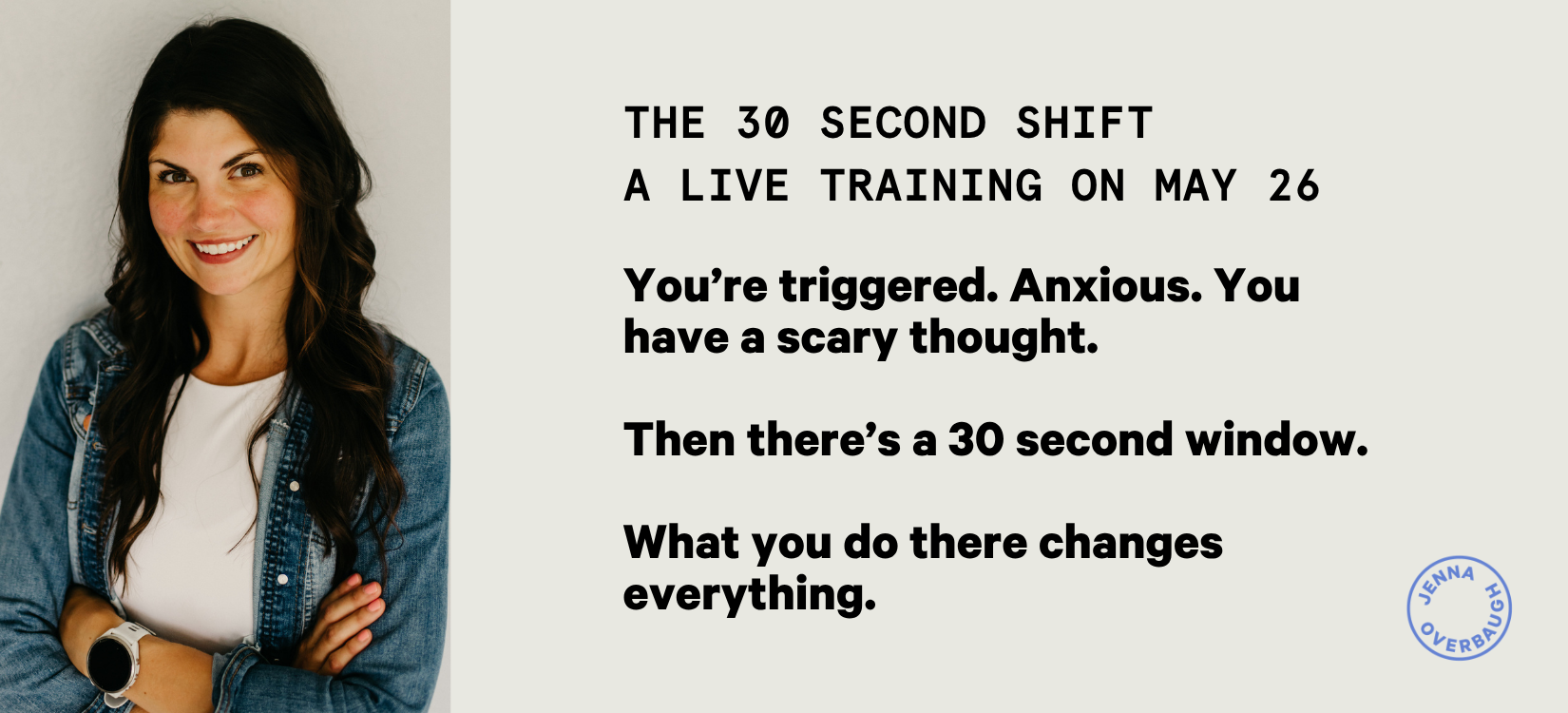
The 30-Second Shift: What to do in the first 30 seconds after an intrusive thought, anxiety spike, or OCD trigger - before it pulls you into the loop
Win the first 30 seconds after the intrusive thought, and everything gets easier. Catch the moment that determines whether you own your mind or your mind owns you.
Live with Jenna on May 26th at 12 PM CST. Replay available. More details below.
You were fine. Like, LITERALLY FINE. And then your brain had a weird ass thought, and you went, "Wait.. what?"
And now, this one weird thought that you did not ask for, do not agree with, and honestly find offensive is somehow running your whole day.
You didn't spiral.. yet. But you did check. Maybe you went back to it a bit, maybe you paused for a second. Tried to make sure you're okay. Noticed how it felt, noticed that you noticed it.
It's all very subtle, all very seemingly reasonable, all DEEPLY unhelpful.
And now. You're here.
This 30 second window is key. It's the difference between you having a thought and the thought having you.
What happens in those 30 seconds after the intrusive thought, the trigger, or the anxiety spike is tiny, but it's everything.
You're not noticing the moment you hand over your control to OCD and anxiety. You just notice that somehow it turned into a whole thing.
So later, you're sitting there and wondering:
"Why am I still thinking about this!?"
"Why does this feel so real!?"
"Why can't I just move on!?"
And the answer isn't, because the thought means something or because it IS real or because you're a horrible person.
It's because you gave over your power in that crucial 30 second period.
This is the fork in the road. The moment where everything gets decided, where the thought and the anxiety either passes, or sits back while you make it comfortable.
Most people miss this 30 second window completely, even people who "know everything there is to know about OCD and anxiety," even people who have been in therapy, even people who can explain the entire OCD and anxiety cycle out loud.
That's what this training is for. Not another explanation of the cycle you already half-know. It's about catching that exact moment - the "hold on..", the "wait!", the "just let me check.." - and doing something different right. There. Before it turns into something you now have to manage for the next 6 hours.
If you've ever said..
- "I just ended up in a spiral"
- "I don't even know what I'm doing wrong"
- "The anxiety just takes over"
Yeah, sooo. This is the part you're missing.
You'll learn:
- how to spot your version of that "hold on…" moment
- the subtle reactions that keep you hooked, including the ones you swear you're not doing (my "but I'm not doing any rituals/compulsions!" people, I'm looking at you)
- why "just checking" keeps it alive
- what to do instead, right there, in real time
So this stops happening:
- "I was fine and now I'm not"
- "why did this turn into a whole thing"
- "I just need to check one more time"
- losing hours of your day to one thought
And this starts happening:
- you catch it sooner
- you don't go down the rabbit hole
- you move on without needing to feel better first
- your day stays… your day
Hi, I'm Jenna, and this is kind of my thing.
I've been treating OCD and anxiety since 2008. Not dabbling in it, not seeing it occasionally between other cases - this is all I've ever done. I've worked with some of the most severe, life-consuming presentations out there, spending almost 10 years at world-renowned residential facilities. The thoughts that scare you the most? They don't shake me. I know exactly what to do next.
I also know this from the inside. I'm not just someone who studied this, I've lived it. So when I tell you your brain isn't broken, I'm not reading that off a slide. I really, really mean it.
Most people who find me already know a lot about OCD and anxiety. They've done the research. They've maybe even done some therapy. They just haven't been shown how to actually work with their brain in the moment in a way that sticks, in a way that makes sense, in a way that doesn't ask you to white-knuckle through it.
That's the difference. Not more explaining but the actual how.
You're not the exception.
You're not too far gone.
You just haven't learned this part yet. That's what we're about to fix.
Details
📅 Tuesday, May 26
🕛 12 PM CST
📍 Live on Zoom
⏱️ 60 minutes + live Q&A
✔️ Replay included (yours forever)
✔️ Live giveaways (be there live if you can)
✔️ Reminder emails + Zoom link sent after signup
Can't make it live? Still sign up. Replay goes out within 24 hours.
Already inside The OCD and Anxiety Recovery Blueprint? You already have free access to this live training + replay as part of your curriculum, so no need to purchase this. We're not able to process refunds due to the fees involved on our end. Your discount code is in your Blueprint Circle community under Discussion Q/A tab. You can also email us at help@jennaoverbaughlpc.com for your coupon code for the event. Again, we cannot process refunds as this costs us each time and it adds up, so please don't purchase! ♡
How is this different from the HANDLE IT Method described in your Hold The Line masterclass? The 30 Second Shift is the fork in the road moment. The HANDLE IT method is what to do when you've already taken a wrong turn and you're in it. Different moments, different tools. The 30 Second Shift is about not stepping into the spiral at all and leaving the thought alone from the start. These two masterclasses are very complementary to one another and will not overlap. Learn more about the HANDLE IT framework in my Hold The Line Masterclass here.
Is this for OCD, or for anxiety, or for a specific subtype? Do I need a diagnosis? The 30 Second Shift is for the moment your brain throws something at you and tries to pull you in an unproductive place. Doesn't matter what the thought is about - health, relationships, intrusive thoughts, whatever. We're changing what you do in that 30 second window, which is the part that actually keeps the whole thing going.